
Andymus Consulting helps industrial clients assess and improve furnace cooling system performance using advanced CFD and FEA. Our work supports longer campaign life, reduced refractory wear, lower operational risk, and more reliable performance across high-temperature process assets.
Engineering challenges in furnace cooling system performance
Cooling systems in electric arc furnaces, blast furnaces, flash smelters, converters, and related vessels operate under extreme thermal and mechanical conditions. Thermal cycling, refractory wear, molten material infiltration, freeze layer instability, boiling risk, and structural loading can all shorten campaign life and increase maintenance and outage exposure if not properly managed.
Cooling systems we can assess
- External shell cooling systems, including spray, film, and air-cooled arrangements
- Stave cooler systems in cast iron, copper, and steel
- Pipe, serpentine, and tube-panel cooling circuits
- Plate, finger, and modular wall cooling elements
- Panel, jacket, and box cooler configurations
- High-intensity cast copper cooling elements and other specialised wall-life components
Images of selected cooling systems
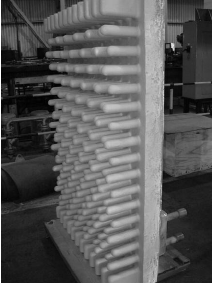
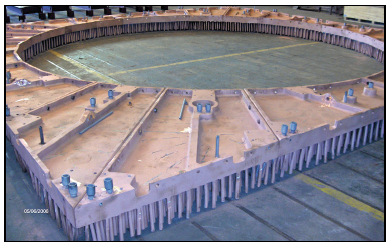
Composite Furnace Module
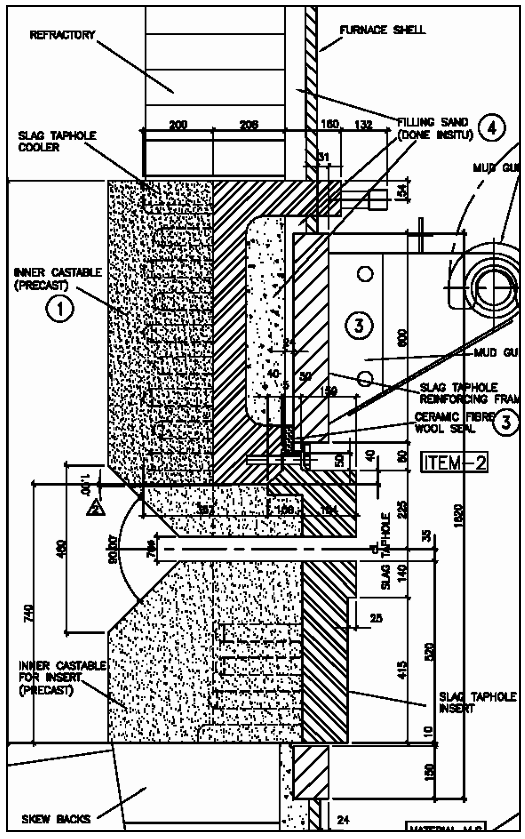
EAF Taphole
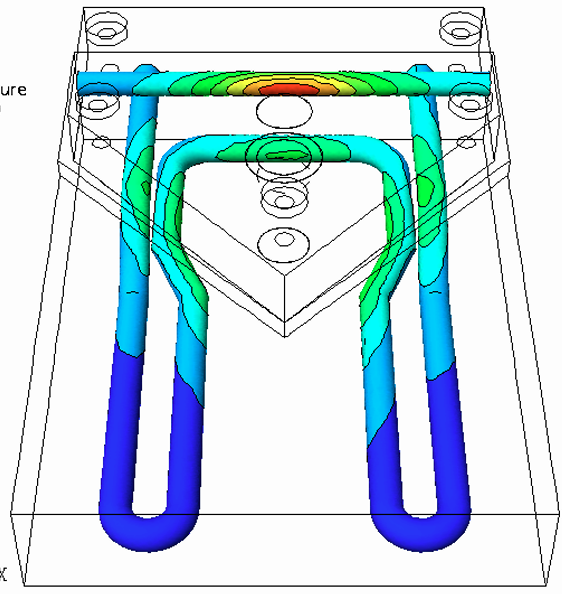
Taphole cooling channel
Assembled cooling elements for a copper electric arc furnace used for cleaning copper slags
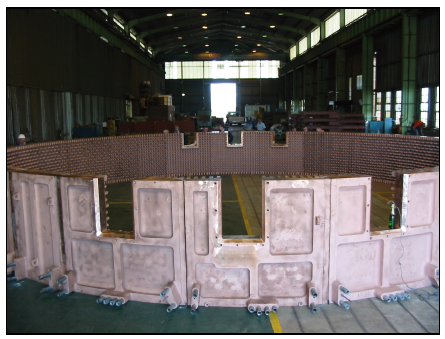
Assembled cooling elements for a copper electric arc furnace used for cleaning copper slags
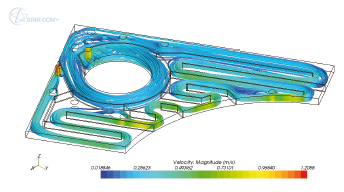
Channel type EAF roof cooling panel CFD modelling
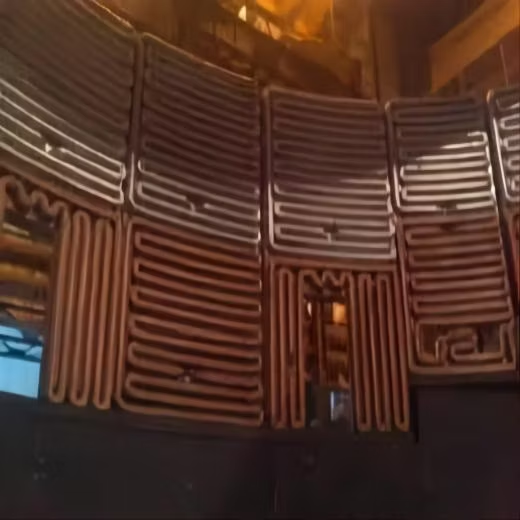
Pipe cooling panels for EAF’s
How we help
We combine high-fidelity modelling with practical engineering judgement to support design decisions, integrity reviews, maintenance planning, and targeted risk reduction for furnace cooling systems.
Computational Fluid Dynamics (CFD) for furnace cooling systems
We use CFD to analyse three-dimensional flow, heat transfer, combustion behaviour, and thermal interactions across the furnace system. This includes modelling gas and particulate flow from the reaction shaft through to downstream equipment such as waste heat boilers, assessing heat transfer within furnace walls and cooling channels, identifying conditions that may trigger thin film boiling, and evaluating the formation of freeze layers and refractory wear. This type of analysis helps clients make more informed design and operating decisions before issues escalate in service.
Finite Element Analysis (FEA) for furnace cooling systems
We apply FEA to evaluate thermal performance, thermo-mechanical stress, structural integrity, installation conditions, and maintenance scenarios for composite furnace modules and other cooling system components. Our work includes checking that copper temperatures remain below critical softening limits, confirming water channel cooling surfaces remain below boiling conditions, assessing the effect of refractory wear, and reviewing load cases during lifting, assembly, operation, and selective replacement of cooling units. The goal is to provide clients with confidence that the design is robust not just in normal service, but also during installation and maintenance events.
Outcomes: longer campaign life, lower risk, better reliability
By combining thermal, flow, and structural analysis, Andymus Consulting helps clients identify failure risks earlier, improve confidence in cooling system design, prioritise maintenance interventions, and support longer, more reliable furnace campaigns. This is particularly valuable where the cost of unplanned shutdowns, rebuilds, or cooling system failure is high.
If you are assessing smelter or furnace cooling system performance, planning upgrades, or looking to better understand thermal and structural risk, Andymus Consulting can help. We bring advanced simulation capability and practical industrial insight to support more confident engineering decisions.
Further Reading
- Verscheure, K., Kyllo, A. K., Filzwieser, A., Blanpain, B., & Wollants, P. (2006). Furnace cooling technology in pyrometallurgical processes. In F. Kongoli & R. G. Reddy (Eds.), Advanced Processing of Metals and Materials, Vol. 4: New, Improved and Existing Technologies – Non-Ferrous Materials Extraction and Processing. The Minerals, Metals & Materials Society (TMS).
https://onemine.org/documents/furnace-cooling-technology-in-pyrometallurgical-processes - Kratz, G. P. (1999, January 12). Kennecott inspecting damage to failed furnace. Deseret News.
https://www.deseret.com/1999/1/12/19422923/kennecott-inspecting-damage-to-failed-furnace/ - Solnordal, C. B., Jorgensen, F. R. A., & Russell, R. (2009). The effect of particle size and composition on the performance of the composite particle model in predicting combustion behaviour in a flash furnace reaction shaft. In Proceedings of the Seventh International Conference on CFD in the Minerals and Process Industries, CSIRO, Melbourne, Australia, 9–11 December 2009.
https://www.cfd.com.au/cfd_conf09/PDFs/012SOL.pdf - Trapani, M., Campbell, A. P., & Montgomerie, D. (2006). CFD modelling assistance for the design of electric furnace slag taphole breast plates. In Proceedings of the Fifth International Conference on Computational Fluid Dynamics in the Process Industries (CFD 2006), CSIRO, Melbourne, Australia, 13–15 December 2006.
https://www.cfd.com.au/cfd_conf06/PDFs/114Tra.pdf - Marx, F., Shapiro, M., & Henning, B. (2010). Application of high intensity refractory cooling systems in pyrometallurgical vessel design. In Proceedings of the Twelfth International Ferroalloys Congress (INFACON XII) (pp. 769–778), Helsinki, Finland.
https://pyrometallurgy.co.za/InfaconXII/769-Marx.pdf - Henning, B., Shapiro, M., Marx, F., Pienaar, D., & Nel, H. (2010). Evaluating AC and DC furnace water-cooling systems using CFD analysis. In Proceedings of the Twelfth International Ferroalloys Congress (INFACON XII) (pp. 849–856), Helsinki, Finland.
https://www.pyrometallurgy.co.za/InfaconXII/849-Henning.pdf
Comments are closed